Most comparisons of this get it wrong in the same way. They put a monthly software fee next to a salary, note that one number is smaller, and stop.
That comparison is dishonest in both directions. It understates what a hire costs, and it badly understates what a hire is worth. A good receptionist is not a phone-answering function — they are institutional memory, judgement, and the person who notices that a customer sounded unhappy. Software does not replace that, and pretending it does is how people end up disappointed.
Here is the comparison done properly.
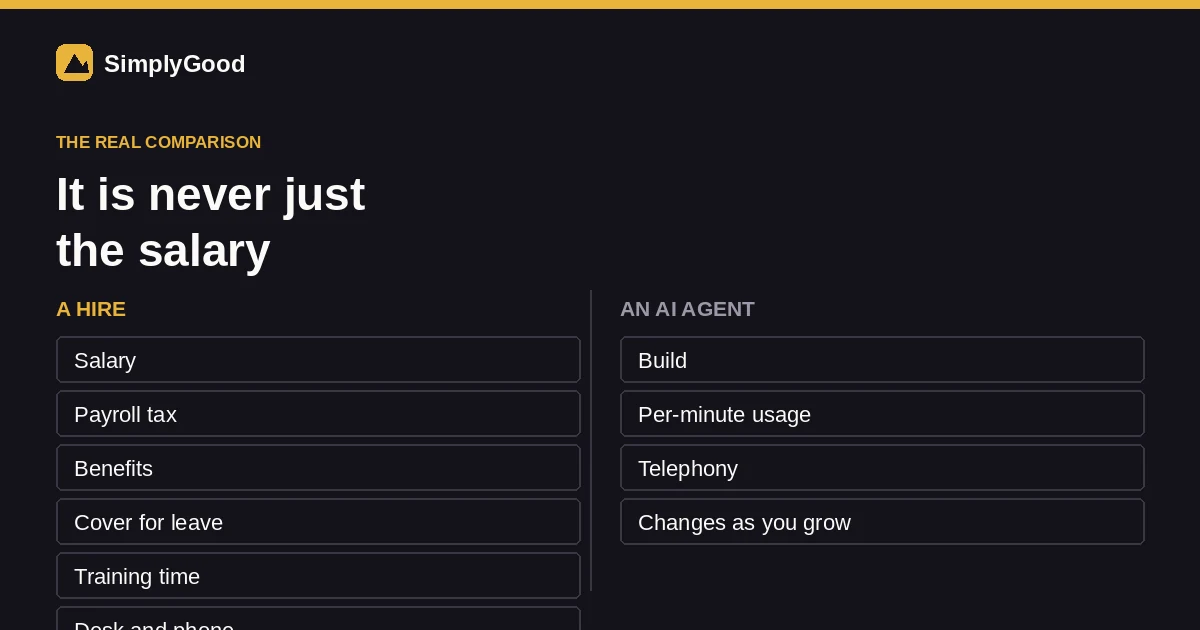 Neither column is just the headline number.
What a hire actually costs
Start with the salary, then add the things that do not appear in the job advert.
Employer payroll costs. National insurance, pension contribution, or the equivalent in your jurisdiction. Typically 12–20% on top of gross.
Paid time off. Statutory leave plus public holidays plus realistic sickness means you are paying for roughly 46 working weeks and receiving about 44.
Cover for absence. This is the one nobody prices, and it is the one that bites. When your receptionist is off, somebody answers the phone — usually the owner, badly, between other tasks. That cost is real even though it never appears on a payroll report.
Recruitment and turnover. Front-desk roles turn over faster than most. Every cycle costs advertising, interview time, and three to six weeks before the new person knows your services well enough to quote confidently.
Training time. The first month is a cost, not a contribution. Someone experienced still needs to learn your service area, your pricing, which jobs you turn down, and which customers are difficult.
Equipment and space. Desk, computer, phone system seat, software licences.
Depending on market, a role advertised at one figure typically costs the business somewhere between 1.25× and 1.4× that figure once all of the above is included. In the US, BLS employer cost data has consistently put benefits at around 30% of total compensation across private industry — a useful sanity check when you build your own number.
And critically: that buys you coverage for about 40 hours a week. Not 168.
What an AI agent actually costs
Same treatment, because the sticker price here is also not the whole number.
Build. Scripting, integration with your calendar and CRM, testing across your real call types. This is the part vendors selling a self-serve product tell you is free, and it is where deployments succeed or fail.
Usage. Usually per-minute. Predictable if your volume is stable, less so if you have storm surges.
Telephony. Numbers, minutes, recording storage. Small but not zero.
Change cost. You will change the script. Prices move, services get added, a suburb gets added to the service area. Whether that costs you a support ticket and a week, or ten minutes in an editor, is worth establishing before you sign.
Your review time. Weekly for the first month, monthly after. Real hours, usually the owner’s.
We break down the numbers and the traps properly in the AI receptionist cost guide. The short version is that the running cost is a fraction of a salary and the build cost is not nothing.
What each one is genuinely better at
This is the part that matters more than the cost comparison, and it is where most write-ups get vague.
A person is better at:
Judgement about exceptions. A customer who has had two failed appointments and is now frustrated needs someone to make a call about a goodwill discount. Software cannot and should not.
Reading tone. A caller who says “it’s fine, don’t worry about it” in a particular voice means the opposite. Humans catch this. Nothing else does.
Anything unscripted. A supplier query, a council inspector, a journalist, an employee ringing in sick. Real phone lines get all of these.
Relationships. Regular commercial customers ring and expect to be known. On a commercial HVAC contract that recognition is part of what the client is paying for.
Everything else in the building. A receptionist also does invoicing, chases suppliers, greets people, and knows where things are. Replacing the phone function does not replace the role.
An AI agent is better at:
Being there. Every hour, including 2am on Christmas Day.
Concurrency. Ten calls at once during a storm. This is not a marginal advantage — it is the difference between capturing a surge and losing it, and it is impossible for one person by definition.
Consistency. It asks for the ZIP code every time. It never forgets to check whether there is a leak. Humans on the fortieth call of a bad day do forget.
Data capture. Structured, complete, in the system, with a recording. No handwriting, no post-its.
Cost at low volume. Forty calls a month does not justify a hire. It might justify an agent.
The scenarios, honestly
You get fewer than about 15 calls a day and no significant after-hours volume. Neither is urgent. Fix your voicemail-to-callback discipline first — that is free, and it is probably the actual problem.
You get a lot of routine calls in office hours and almost nothing after. Hire, if you can afford it. Your calls are during hours a person can cover, and they involve enough variety that judgement helps. An agent here is solving a problem you do not have.
You get significant evening and weekend volume. An agent, almost certainly. A hire does not cover those hours, and a rota across a small team is not sustainable. This is the most common situation for trades — see the after-hours arithmetic.
You have surges — storms, freezes, seasonal peaks. An agent, for concurrency. Even with a receptionist on staff, the surge is what you cannot cover.
You already have a receptionist who is drowning. Both. This is the underrated answer. The agent takes the routine bookings and the out-of-hours calls; the person keeps the judgement calls and gets to do the rest of their job properly. Framing this as replacement is what makes it fail politically inside a business.
You are a single-operator trade working on the tools all day. An agent. You cannot answer a phone with your hands inside a boiler, and a hire is not viable at your scale. This is the clearest case there is, and it applies to most of the trades we work with — from locksmiths to mobile auto repair.
The mistake that ruins this
The most common failure we see is not technical. It is buying an agent to replace a person, without deciding what the person’s job becomes.
Two things go wrong. The obvious one: the remaining human work (the exceptions, the awkward calls, the supplier chasing) lands on the owner, who is now doing reception between jobs. The less obvious one: the team treats the system as a threat and quietly routes around it, which they can do, because they answer the phone before it does.
The deployments that work are framed as coverage extension rather than headcount reduction. The agent takes the hours and the call types nobody wanted anyway. Nobody is asked to justify their job. Adoption is not a fight.
If the actual goal is to reduce headcount, that is a legitimate business decision, but be honest about it internally rather than letting people work it out. Discovering it sideways is what turns a tool into an enemy.
A middle path most people miss
You do not have to choose between full coverage and none.
Run the agent only outside office hours, or only on overflow when the main line is engaged, or only for one call type — new booking enquiries, say, with everything else forwarding straight to a person. Overflow-only is a particularly good starting point: your receptionist keeps every call they can take, and the agent catches the ones that would currently ring out.
This is also the lowest-risk way to test the thing. Your existing coverage is untouched, so the downside is bounded, and after a month you have data on what it caught rather than a projection.
The question that settles it
Forget the cost comparison for a moment and ask this instead:
Of the calls you currently miss, how many are routine?
If the answer is most of them (bookings, availability, straightforward quotes) an agent captures a large share of what you are losing, and the case is strong.
If the answer is that your missed calls are complicated, commercial, relationship-driven conversations, then software will handle them badly and you need a person, or a better rota, or fewer calls.
Most service businesses, when they actually listen to a sample of their missed calls, find the first answer. The volume is routine. It is just routine at inconvenient hours.
Frequently asked
One number that settles most arguments
If the decision is stuck, calculate cost per captured lead for each option and compare those rather than the monthly figures.
For a hire: fully-loaded annual cost divided by the number of enquiries they will actually handle in a year. Be honest about the second number, including the hours they are not there.
For an agent: build cost amortised over twelve months plus a year of usage, divided by the enquiries it handles.
The comparison usually surprises people in one direction or the other, and it surfaces the thing the monthly-cost comparison hides: the hire is expensive per lead at low volume and gets cheaper as volume rises, while the agent is roughly flat. Where those lines cross is your answer, and it is a different point for every business.
Can I start with an agent and hire later? Yes, and it is a sensible order. The call data the agent produces makes the eventual hiring decision much better informed — you will know exactly what volume and what mix you are hiring for.
What do I tell customers? That you have automated assistance for bookings and out-of-hours calls, and that a person is available on request. Brief and honest beats concealed. We cover why in do AI receptionists sound human.
Will my existing receptionist resent it? Less than you fear if it is introduced as taking the calls nobody wanted — the 8pm ones, the surge, the fifth simultaneous caller. Considerably more if it arrives unannounced.
What if it books something wrong? It will, occasionally. Read-back on the fields that cost money to get wrong (number, address, slot) catches most of it. The rest is why you review recordings for the first month.
Is there a volume where a hire is clearly better? When the calls need judgement rather than when they are numerous. A business with forty complex commercial calls a day needs a person. One with two hundred routine bookings does not.
Not sure which side you fall on? Tell us what your call mix looks like — including the ones you currently miss, and we will give you a straight answer, including “hire someone” if that is the right one.