Ask a business owner how many calls they miss and you will usually get a number like “a couple a week”. Ask their phone provider and the answer is generally several times higher.
The gap matters, because missed calls are the only marketing problem that costs you money without appearing anywhere. There is no line item, no bounce rate, no failed delivery report. Someone rang, nobody answered, and they called the next result.
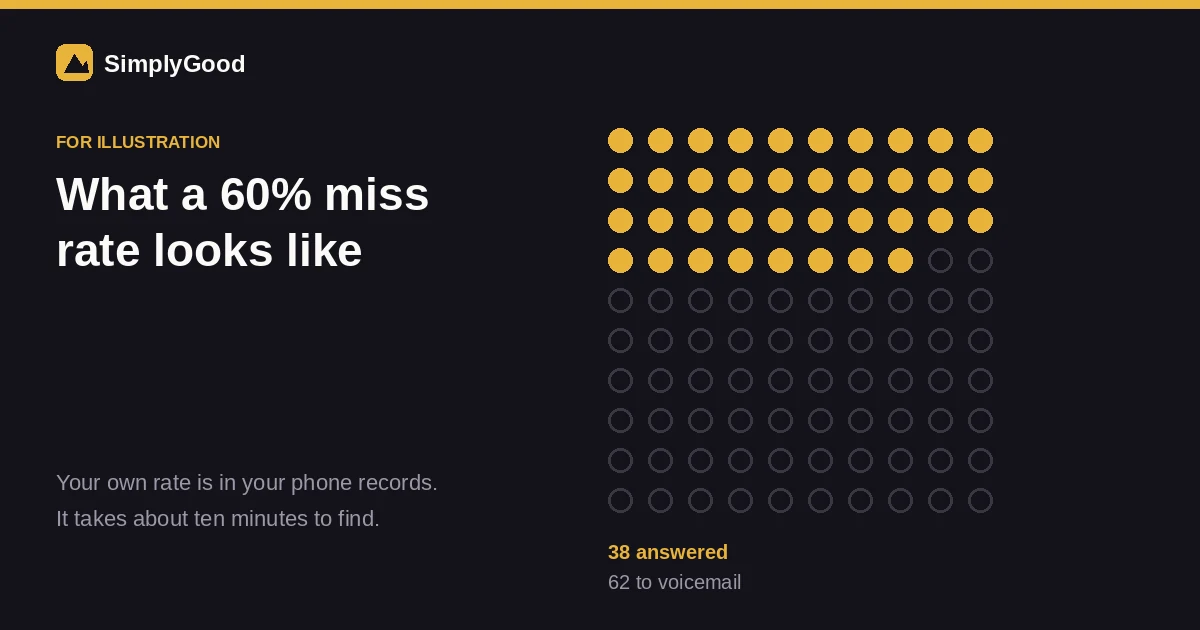 An illustration of what a 60% miss rate looks like, not a measurement of your business.
Why you should distrust the published numbers
Search this question and you will find the same few statistics repeated everywhere: a specific percentage of calls missed, a specific percentage of voicemails never returned, a dollar value per missed call.
Follow those numbers back to their source and the trail usually ends at a vendor selling call answering. Sometimes the underlying sample is a few hundred calls at a handful of businesses; sometimes there is no published methodology at all, just a figure that got quoted, then re-quoted, until it acquired the authority of a fact.
We are not going to repeat them here, for two reasons. The first is that we cannot verify them and neither can you. The second is more practical: even a well-conducted study of other people’s phones tells you nothing actionable about yours. A dental practice with a full-time front desk and a solo locksmith working from a van do not have the same number, and averaging them produces a figure that describes neither.
What is worth knowing is the mechanism rather than the magnitude. Missed calls are structurally invisible: they generate no record you look at, no notification, and no memory. That is why almost every owner who measures it finds a higher number than they guessed, and it is the only part of this you can rely on before you check.
So the rest of this article is about getting your own number, which takes about ten minutes and is worth more than any benchmark.
Why owners underestimate it
The bias is structural, not carelessness.
You only see the calls you answered. The ones you missed leave no impression. There is no moment where you experience the loss, so there is nothing to remember.
Voicemails feel like the missed calls. They are not. They are the fraction who bothered to leave one, and that fraction is small. Whatever it is for your business, five voicemails represents a considerably larger number of people who rang and said nothing — your call log will tell you the ratio.
Peak times are invisible. The calls you miss cluster precisely when you are busiest, which is also when you are least likely to notice a phone ringing.
After-hours is a blind spot. Nobody is there to observe the phone not being answered.
Measuring your own rate
This takes about ten minutes and it is the only number that matters.
If you use a VoIP system — RingCentral, Dialpad, 8x8 or Google Voice — the call log has what you need. Export the last 90 days and count total inbound against answered. Most of these systems report a missed-call rate directly.
If you use mobiles, your carrier’s online account usually shows call history. Less convenient, same principle.
If you genuinely cannot get the data, run a manual count for two weeks. Tally every call and whether it was answered. Two weeks is enough to see the shape.
Then break the number down three ways, because the total tells you less than the pattern:
- By hour. Do misses cluster at 8am, at lunch, at 5pm?
- By day. Mondays after a weekend of accumulated problems are usually the worst.
- In hours versus out of hours. This one usually decides what to do about it.
Reading what you find
The pattern points at different fixes, and they are not interchangeable.
Mostly after hours. The cheapest problem to solve, and the most common. Nobody is expected to be there, so nothing about your daytime operation needs to change. An AI receptionist covering evenings and weekends addresses exactly this.
Clustered at peak hours. Simultaneous calls beating a single person. Adding staff fixes it expensively and only up to a point, because the peak is by definition the hardest hour to staff for.
Spread evenly through the day. Usually a process problem rather than a capacity one — the phone is nobody’s actual job, so it rings while everyone assumes someone else will get it.
Very few missed at all. Then this is not your bottleneck, and you should be spending your attention on getting more calls rather than answering them better. We would rather tell you that than sell you something.
The number that decides it
Once you know your missed-call rate, one calculation tells you whether it is worth fixing.
missed calls per month
  × your close rate on answered enquiries
  × average job value
  = monthly revenue currently going elsewhere
Twenty missed calls, a one-third close rate, an $800 average job. That is roughly $5,300 a month.
Two missed calls, a one-in-five close rate, a $90 average job. That is $36, and you should ignore it entirely.
Both are real businesses. The arithmetic is what separates a problem worth solving from a statistic that sounds alarming.
What to do about it
In rough order of cost:
Change your voicemail greeting. Free. Most greetings say nothing useful. One that states when you will call back, and offers a text option, measurably improves callbacks.
Add a text-back. Many phone systems can auto-text a missed caller within seconds. Note that automated texts to customers are regulated in the US — the FCC’s TCPA rules govern what you may send and when, and a reply to someone who just rang you sits in very different territory from a marketing blast. Cheap, and it catches people who are still deciding.
Route overflow somewhere. A second number, a colleague, anywhere other than voicemail during your peak hour.
Cover after hours properly. Either a service, or an AI receptionist that answers, triages and books rather than taking a message. Our guide on what that costs has the real numbers, and how it compares to a traditional answering service covers when a human service is the better answer.
Hire someone. Genuinely the right answer for some businesses, and the most expensive.
What the number does not tell you
A missed-call rate is a useful headline and a poor diagnosis on its own. Two businesses with an identical 40% rate can have completely different problems.
Repeat callers inflate it. If someone rings three times in ten minutes and gets through on the third, most systems log two missed calls. That is one frustrated customer, not two lost ones, but it is also a customer who nearly left. Worth separating, because the fix is different: they reached you eventually, so the problem is wait time rather than coverage.
Spam and wrong numbers deflate its meaning. Every business number attracts a share of automated calls. If a fifth of your inbound is junk, your real missed-call rate on genuine enquiries is lower than the raw figure suggests. Sampling fifty numbers against your customer list tells you roughly how much to discount.
Very short calls hide a problem. A run of eight-second answered calls usually means someone picked up, said “can you hold”, and the caller left. Those count as answered and behave like misses.
So look at three numbers together: the raw rate, the rate excluding repeat attempts within an hour, and the count of answered calls under fifteen seconds. The gap between the first and the last is where the real story sits.
Why voicemail performs so badly
The obvious response to missed calls is a better voicemail greeting. It helps a little, and it is worth knowing why it helps so little.
Voicemail asks the caller to do three things in sequence: wait through a greeting, compose a message on the spot, and then wait an unknown amount of time for a reply. Every one of those is friction, and the third is the one that kills it — the caller has no idea whether you will ring back in ten minutes or tomorrow, and they have a problem now.
Compare that with the alternative available to them: hanging up and tapping the next search result. That takes two seconds and carries no uncertainty at all.
This is why the callback rate from voicemail is so low, and why it drops further for urgent trades. Someone booking a haircut might leave a message. Someone standing in water will not.
The practical implication is that improving your voicemail is optimising the wrong step. The win is in not reaching it.
A worked example
The numbers below are invented to show the method. Substitute your own — the point is the sequence of adjustments, not the figures.
Take a two-van plumbing company whose quarterly VoIP export shows 412 inbound calls, 233 answered, 179 missed. A 43% miss rate.
Breaking it down changes the picture:
- 34 of the missed calls were second or third attempts within an hour. Real distinct missed callers: about 145.
- 22 were flagged as likely spam. Genuine missed enquiries: roughly 123.
- Of those, 81 arrived outside 8am–6pm.
So the headline is 179 and the actionable number is 81 out-of-hours enquiries a quarter — 27 a month.
At an average job value of $420 and a close rate of 30% on answered enquiries, those 27 calls represent roughly $3,400 a month of work going to whoever answered instead.
That is the calculation worth doing, and note what it produced: a direction as well as a figure. The daytime operation here is handling its calls adequately, so the answer is after-hours coverage rather than another hire. Run the same arithmetic on your own export and it will point somewhere specific too — possibly at doing nothing.
Frequently asked
What is a typical miss rate? There isn’t a useful one. The figures circulating online mostly originate with companies selling call answering, and the variation between a staffed dental practice and a solo tradesman is larger than any average is worth. Your own export is the only number to act on.
Do missed calls really not call back? Most do not, and the reason is competitive rather than rude. Someone with a blocked drain is working down a list, and you were one entry on it.
What if most of my enquiries come by form? Then measure form response time instead. The same principle applies — speed of response predicts conversion, but the fix is different.
Is there a rate I should be aiming for? Below 10% on genuine enquiries during staffed hours is a reasonable target and achievable with better routing alone. Out of hours the honest target depends entirely on what coverage you are willing to pay for.
Does a missed call from a mobile count differently? Not really, though mobile callers are marginally more likely to try again because redialling is one tap. Do not read too much into that — most still go elsewhere on the second failure.
Our phone system does not report missed calls. Then count manually for two weeks. Tally every ring and whether it was answered. It is tedious and it is also the only way to get a number you can act on.
Should I answer calls during jobs? Usually not, and this is the false choice that keeps the problem alive. The options are not “interrupt the work” or “lose the call”. Something else answering is the third one.
Want to know what your missed calls are worth? Tell us your rough call volume and what happens to them after hours. You will get a written answer within one business day, including an honest “this is not your problem” if the numbers say so.