What each one actually is
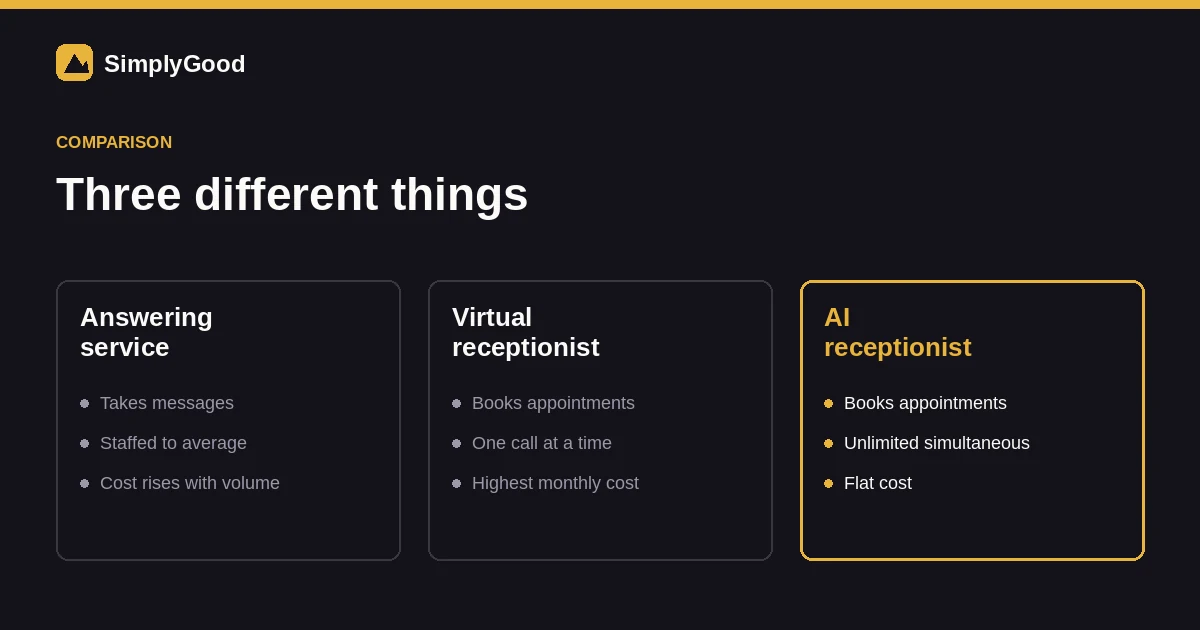
These get discussed as if they were the same product at different prices. They are not, and the differences matter more than the cost.
- A traditional answering service is people in a call centre taking messages for many businesses. They answer, they write down what was said, they pass it on.
- A virtual receptionist is a person, often dedicated to you or a small group of clients, who can book appointments and use your systems.
- An AI receptionist is software that holds the conversation itself, works from rules you set, and writes to your calendar or CRM directly.
Side by side
The differences that actually decide it, rather than the marketing ones.
| Answering service | Virtual receptionist | AI receptionist | |
|---|---|---|---|
| Typical monthly | $100 – $400 | $300 – $1,500 | $100 – $300 |
| Answers at 2am | Usually, at a premium | Sometimes | Always, same cost |
| Simultaneous calls | Limited by staffing | One at a time | Effectively unlimited |
| Books into your calendar | Rarely | Yes | Yes |
| Knows your prices and services | Basic script | Yes, over time | Yes, as configured |
| Handles genuine judgement calls | Yes | Yes | Escalates to you |
| Quality varies by who is on shift | Yes | Less so | No |
| Cost of a busy month | Rises | Rises | Flat, on flat-rate plans |
Where each one came from
The three are often presented as generations of the same idea. They are not — they solved different problems in different decades, which is why their strengths sit where they do.
Answering services began as literal switchboards, then became call centres. The product was always the message: somebody writes down who rang and what they wanted. That is why they scale by staffing and why quality varies with whoever is on shift.
Virtual receptionists emerged when small businesses wanted the call centre to do more than take a name — to know the business, use its systems and book real appointments. Better outcomes, one call at a time, at a price reflecting a dedicated person.
AI receptionists arrived when speech recognition and language models became good enough to hold a real conversation. The unlock was not intelligence, it was capacity: software has no concept of being on another call.
Understanding that history explains the pricing. You are paying for messages, for a person, or for capacity, and those cost very different amounts to provide.
The questions people actually worry about
Two objections come up in nearly every conversation, and both deserve a straight answer rather than reassurance.
"Will it embarrass us?" It can, in one specific way: by confidently saying something wrong. That is a configuration failure rather than a technology one, and it comes from a vendor loading a generic script instead of your actual services and prices. The defence is a tight brief and an escalation path that triggers early — an agent that says "I will get someone to confirm that" is doing its job.
"Will customers feel fobbed off?" Some will, particularly older callers and anyone already annoyed. The mitigation is a fast route to a human for anyone who asks. What is worth weighing against that is the alternative: nobody is delighted by voicemail either, and most callers who reach one simply ring the next company.
Neither objection is a reason not to do it. Both are reasons to build it properly and to keep listening to recordings after launch.
Where the AI genuinely wins
Two situations, and they are the ones most service businesses are actually in.
The first is spikes. A storm, a heatwave, a burst-pipe cold snap. A call centre staffs to an average and a virtual receptionist takes one call at a time, so both fail exactly when demand is worth the most. Simultaneous calls are not a constraint for software.
The second is consistency. It asks the same intake questions in the same order on the hundredth call at 3am as on the first. Human services vary by who is on shift, and message-taking services in particular tend to capture less than you would like.
Where a human service is still better
We would rather say this plainly than pretend otherwise, because selling the wrong thing costs us more than the sale is worth.
If your calls are emotionally difficult — bereavement services, healthcare with distressed patients, anything where the caller needs to feel heard more than they need an appointment — a person is better, and it is not close.
There are regulatory angles too. In healthcare, anything touching patient information falls under HHS guidance on HIPAA, and any vendor in that chain needs to be able to sign a business associate agreement. Ask about that before the demo, not after.
If your enquiries are genuinely complex and every one is different, a person who learns your business over months will outperform configured rules.
And if your call volume is very low, a few a week, the setup effort is hard to justify against simply answering the phone.
Working out which you need
Rather than comparing feature lists, answer four questions about your own calls. The answers point somewhere specific.
- When do your missed calls cluster? If they are mostly after hours and at peak times, an AI receptionist addresses exactly that shape. If they are spread evenly through the day, you have a staffing problem and a person is the honest answer.
- Do two calls ever arrive at once? If yes, that alone rules out a virtual receptionist, who can take one. Simultaneous capacity is the clearest structural difference between the three.
- Does the caller need to feel heard, or need an appointment? Bereavement, distressed patients, sensitive legal matters — a person, every time. A booking, a quote, a status check — software handles it consistently.
- How much does a good month cost you? Human services bill more when you are busier. Flat-rate software does not. If your trade spikes, that difference compounds exactly when you can least afford a surprise.
What each one costs you when it fails
Every option fails sometimes. What matters is the shape of the failure, because they are not equivalent.
An answering service fails quietly. A message is taken badly, details are wrong or missing, and you find out when you call back and the customer has already booked elsewhere. You rarely learn it happened.
A virtual receptionist fails by being busy. They are on another call, so yours goes to voicemail. The failure is invisible to them and to you.
An AI receptionist fails visibly. It mishandles a question and you hear it on the recording, because every call is logged. That is uncomfortable and it is also the only failure mode you can actually fix.
That last point is worth weighing. A system whose mistakes you can review is easier to improve than a system whose mistakes are invisible, but it does mean somebody has to listen in the first fortnight.
Switching without breaking anything
If you are moving from a human service, do it in stages rather than all at once. The staged version is slower and it is also how you avoid discovering a routing problem with live customers on the line.
- Week one: after-hours only. The calls currently reaching voicemail. Nothing you already handle changes, so there is no downside risk.
- Week two: review every recording. Not a sample. You are looking for the three questions it asks badly, and they will be obvious.
- Week three: add overflow. Calls arriving while your line is engaged. Your daytime handling is untouched.
- Week four: decide. Compare enquiries captured against the same period before. If the number has not moved, stop, and any vendor unwilling to have that conversation is telling you something.
The hybrid most businesses land on
This is what we most often recommend, and it is rarely what anyone sells you.
The AI takes after-hours, weekends and overflow — the calls currently reaching voicemail, which is where the loss actually is. Your existing team keeps daytime calls, where relationship and judgement matter. Anything the agent is unsure about escalates to a person rather than being forced through a script.
That way you are not replacing anything that works. You are covering the hours that currently produce nothing.
If you are weighing this per trade rather than in general, the industries pages cover what the calls actually look like in each one, and what it costs has the numbers.
The handover problem nobody mentions
Both options create the same risk at the same point: the moment information leaves them and has to reach you.
An answering service takes a message and sends it, usually by email or SMS. That message arrives in an inbox alongside everything else, and whether it gets actioned depends on somebody noticing it. Plenty of businesses pay for a service that captures calls perfectly and then lose the leads at this step, which is invisible on any report either party produces.
An AI agent writes into a system, which is better in principle and worse when it breaks. If the calendar write fails and the design was not persist-first, the lead disappears silently. Ask any vendor what happens when their integration target is down — the right answer is that the lead is stored first and the integration attempted afterwards, so a failure costs you a manual entry rather than a customer.
Whichever you choose, test the handover deliberately in week one. Ring your own number out of hours, then follow the resulting lead all the way to whoever is supposed to act on it. Most problems in this category are found in that ten-minute exercise.
What each one does to your reputation
There is a cost to both options that never appears in a comparison table, and for some businesses it outweighs everything else on the page.
An answering service answers as you. If the operator is disengaged, bored, or clearly reading from a card, the caller attributes that to your business rather than to a contractor three time zones away. This is the most common complaint about the category, and it correlates with price: the cheapest services are cheapest because of how many accounts each operator is covering at once.
An AI agent carries the opposite risk. The failure is not indifference, it is rigidity — a caller with an unusual situation being walked through a script that does not fit. Handled well this ends in a fast transfer. Handled badly it ends with someone telling other people that you replaced your phone with a robot.
The mitigation is the same for both: listen to real calls in the first month. Not a sample the vendor selects, and not a monthly summary. Twenty actual recordings, chosen at random, including the short ones where the caller hung up. Whatever is wrong will be obvious within the first five.
Running them in parallel
If you already have an answering service and are considering switching, the low-risk approach is to run both for a month rather than cutting over.
Point the AI agent at overflow and out-of-hours, leave the answering service on its existing lines, and compare two things at the end: captured leads that turned into booked jobs, and the number of calls each handled that the other would have dropped. Impressions are not useful here, and neither is call quality on its own — a beautifully handled call that produces no booking is not the outcome you are buying.
A month is usually enough to see the pattern, though if your business has genuine seasonality you want the comparison to include a busy stretch. The surge is where the two diverge most sharply, because concurrency is the one thing a staffed service cannot flex quickly.
The other reason to overlap: it removes the pressure to make the new thing work. Deployments made under a burnt-bridge deadline get rushed configuration, and rushed configuration is what people are describing when they say this technology did not work for them.