The three things you are actually paying for
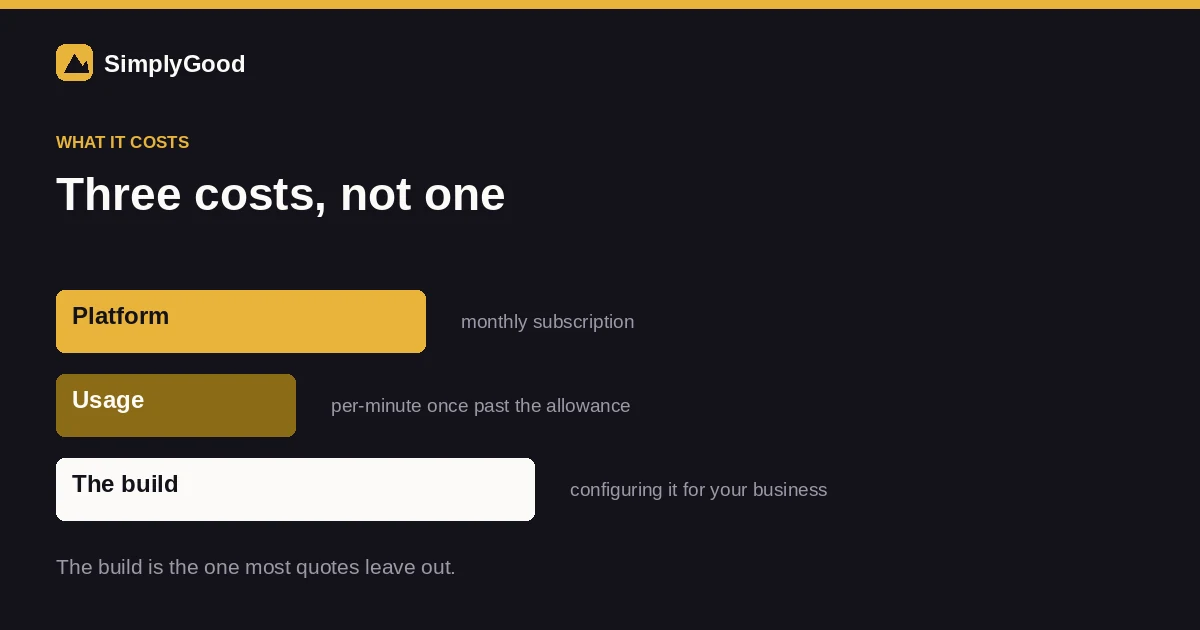
Pricing looks confusing because vendors bundle three different costs into one number, and each behaves differently as you grow.
Separating them is the only way to compare quotes honestly, and it is the reason two proposals for "an AI receptionist" can differ by a factor of ten.
- The platform — the software that answers, listens and speaks. Usually a monthly subscription, sometimes with a minute allowance.
- The usage — per-minute or per-call charges once you pass the allowance. This is the one that scales with your success.
- The build — configuring it for your business: your services, your triage rules, your calendar, your CRM. Usually a one-time cost, and the one most often missing from a quote.
Typical market pricing in 2026
Across the vendors we have looked at, published pricing clusters into three bands. These are the platform and usage costs, not the build.
| Tier | Typical monthly | What you get |
|---|---|---|
| Entry / self-serve | $30 – $99 | Limited minutes, generic script, no real integration |
| Small business | $100 – $300 | Higher or unlimited minutes, calendar booking, basic routing |
| Flat-rate unlimited | $150 – $700 | Unlimited calls, multiple agents, CRM integration |
Per-minute versus flat rate
Metered pricing sits around $0.50 to $1.50 per call in most published rate cards. That is attractive at low volume and becomes the wrong shape the moment the thing works.
The perverse result of metered pricing is that a good month costs you more. A storm week for a roofer, or the first cold snap for an HVAC company, is exactly when you want the phone answered without watching a meter. Flat-rate plans cost more at rest and stop you flinching at your own success.
Our general advice: if your call volume is genuinely low and steady, metered is cheaper. If it spikes, or if you are buying this precisely because of the spikes, flat rate is the honest choice.
The build cost nobody quotes
An AI receptionist that has not been configured for your business is a worse voicemail. It needs your services, your prices, your service area, your triage rules, your calendar and your escalation path. That is work, and it is where most implementations succeed or fail.
Self-serve platforms hand you the configuration and a text box. Some businesses do it well. Most do it once, badly, and conclude the technology does not work.
A properly scoped build (the calls mapped, the rules written, the integrations tested against real traffic) typically runs from a few thousand dollars depending on how many call types and systems are involved. We quote it as a fixed scope so you know before you commit.
If you want to see what the underlying platforms actually charge before talking to anyone, the pricing pages at Twilio and ElevenLabs show the per-minute voice and speech costs that sit beneath every vendor quote in this market, including ours.
What the build actually involves
Vendors describe setup as though it were a form. It is closer to writing a job description for someone who will never use judgement, which is why the businesses that succeed here treat it as a real piece of work.
Six things have to be decided, and none of them can be guessed on your behalf.
- Your services, priced. What you do, what it costs, and which prices are fixed versus quoted after a visit. Anything you leave vague becomes something the agent has to dodge on a call.
- Your service area, honestly drawn. Not the counties you would like to cover — the ones you actually attend. An agent that books a job ninety minutes outside your radius costs you more than a missed call.
- Your triage rules. What counts as an emergency in your trade, and what happens when one arrives. This is the field where two companies in the same industry answer completely differently.
- Your availability. Real diary, real slot lengths, real buffers. A booking system that offers slots you cannot honour damages you faster than voicemail does.
- Your escalation path. Who gets the call when the agent is out of its depth, by what channel, and how fast. Getting this wrong is the single most common cause of a failed rollout.
- Your handover to a human. Every caller who asks for a person should reach one. That path has to exist and be tested, not assumed.
The costs that show up later
Three things routinely surprise people in month two, and none of them appear on a pricing page.
Number porting or a new line. If the agent answers your existing number you need call forwarding, which your phone provider may charge for. If it gets its own number you are now managing two, and every listing showing the old one needs updating — including your Google Business Profile, which is where most local calls originate.
Integration work. Writing bookings into your calendar is straightforward. Writing them into an older field-service or practice-management system with no public API is not, and that is where a quote moves by thousands. Establish which case you are in before signing anything.
Iteration in the first month. No agent is right on day one. You will listen to calls, find three questions it asks badly, and change them. Budget for that fortnight rather than treating it as a fault.
Questions to put to any vendor
These separate a real proposal from a demo. We would expect to answer all of them, and so should anyone else you are considering.
- What happens to a call it cannot handle — voicemail, a mobile, or a human service?
- Can I hear recordings of my own calls, and how long are they kept?
- Who owns the phone number and the call data if I leave?
- Is the price metered or flat, and what does a heavy month cost?
- What is included in setup, and what is billed hourly afterwards?
- How long from signing to answering a real call?
- What does it do when someone asks to speak to a person?
What it should be compared against
The comparison people reach for is a full-time receptionist, which published guides put at roughly $35,000 to $50,000 a year once benefits and overhead are counted. That framing flatters the software, because most small businesses were never going to hire one.
The honest comparison is against what you do now: calls to voicemail after hours, a shared mobile, or an answering service that takes a message. And against the cost of the calls you currently miss — our post on how many calls a small business actually misses walks through measuring that from your own phone records.
For a sense of what the labour alternative costs, the US Bureau of Labor Statistics publishes median pay for receptionists, which is a firmer number than the salary figures vendors tend to quote.
What you are actually paying the builder for
The platform fee is the visible number. The build is the one that decides whether the platform fee was wasted, and it is worth knowing what the work consists of so you can judge a quote.
Most of it is not technical. It is extracting decisions that currently live in somebody's head and writing them down: which jobs you turn down, what counts as an emergency, how far you travel, what you charge for a call-out, which questions have to be asked before anyone is dispatched. Every business believes this is already documented and almost none of them find that it is.
The technical portion is integration and testing. Connecting the calendar so bookings respect real availability, connecting the CRM so leads land where somebody looks, and then running the whole thing against a set of real call recordings to see where it breaks.
A quote that includes none of this is selling you a configured demo. That can be the right purchase at a small scale, and you should know that is what it is.
The pricing models, and what each one punishes
Three shapes dominate the market, and the differences matter more than the headline rate.
Per minute. You pay for talk time. Predictable when your call mix is stable, and it quietly penalises the calls you most want to go well: a caller who needs a bit of patience costs more than one who does not. It also means a badly-designed failure path burns money producing nothing, because three retries and a transfer attempt that rings out are all billable minutes.
Per call. Simpler to forecast and the incentive runs the other way, toward brevity. Watch the definition of a call: some providers bill a connection regardless of length, which makes a month of spam calls surprisingly expensive.
Flat rate with an allowance. Easiest to budget, and the one we usually suggest starting on. The thing to check is the overage rate, because that is where a storm week turns a $150 month into something else entirely.
Whichever you pick, model a bad month before you sign — triple your normal volume and see what the bill does. If nobody can tell you, or the answer is uncapped, ask for a cap or a spend alert. The buyer checklist in how to choose an AI phone agent goes through the rest of the commercial terms worth pinning down.
What it costs when it goes wrong
Two failure costs are worth pricing in, because neither shows up on a quote.
The first is a booking made incorrectly. A wrong address or a mis-heard phone number costs a truck roll, and for most trades that is more than a month of subscription. This is entirely preventable with read-back on the fields that matter, but only if somebody specified it — which is why the build is not the part to economise on.
The second is a lead captured and never actioned. An agent that takes a callback number at 11pm has created an obligation. If nobody rings back, you have paid to make a customer feel ignored, which is worse than having missed the call outright. Whoever owns the morning callback queue needs to be named before you go live, not after.
Both of these are process costs rather than software costs, and they are the reason a cheap platform with no configuration is often the more expensive choice.
Working out whether it pays
Three numbers, and rough figures are fine.
Take your average job value. Multiply by the proportion of enquiries you convert. That is what one answered call is worth. Then estimate how many calls a month currently reach voicemail — your phone records will tell you, and the number is usually higher than owners expect.
If a job is worth $600, you close a third of enquiries, and you miss twenty calls a month, the arithmetic is not close. If a job is worth $80 and you miss two calls a month, it probably is not worth it, and we would tell you so.
How this plays out varies by trade. The HVAC and roofing pages cover the spike-driven case, where the value sits in a handful of weeks a year; dental is the steady-drip case, where it is the new-patient call at lunchtime.