This is the first question almost everyone asks, and it usually means something more specific: will my customers be annoyed?
The honest answer is that voice quality is no longer where these systems fail. Synthesis has got good enough that a short exchange (name, address, what is wrong) passes without comment from most callers. What gives an AI agent away is almost never how it sounds. It is how it behaves when the conversation stops going to plan.
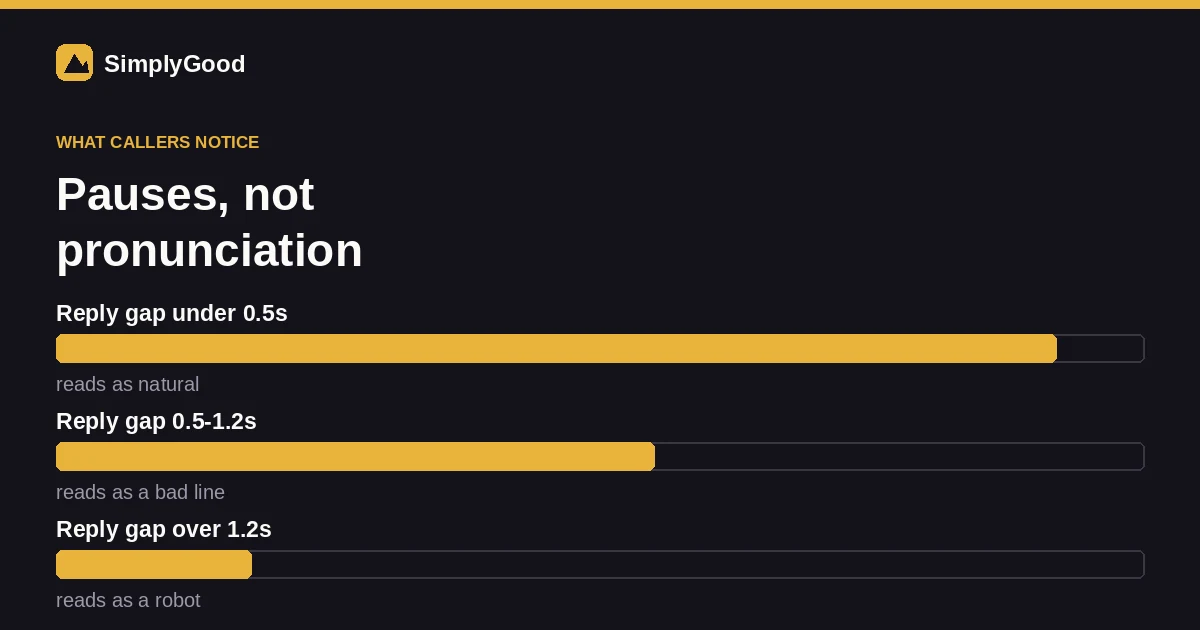 Callers forgive an odd voice. They do not forgive an odd pause.
What people actually notice
Sit and listen to a hundred recorded calls and the pattern is consistent. Callers rarely comment on the voice. They react to three other things.
The gap before a reply. Human conversation runs on very short turn-taking gaps — typically around 200 milliseconds, which is faster than we can consciously plan a response. Linguists studying turn-taking across languages found this timing is remarkably consistent worldwide, which suggests it is close to hardwired. When a reply arrives a full second late, the caller does not think “that is a machine”. They think something is wrong with the line, and they start talking over the top of it.
Whether it acknowledges what was just said. A human says “right” or “okay” mid-sentence. Without those, a caller cannot tell whether they are being heard, so they repeat themselves, and repeating yourself to something that does not acknowledge you is the single most frustrating experience in phone automation.
What happens the first time something unexpected comes up. A caller mentions their landlord, or asks whether you take a particular insurance, or says the address is “the one behind the church”. A system that handles that gracefully passes. A system that returns to its script does not.
Notice that none of the three is about audio quality.
Where it still gives itself away
Being straight about this matters more than selling it, because the failure modes are predictable and mostly fixable.
Genuine distress. Someone whose ceiling is coming down is not going to be spoken to calmly and told the next available slot is Thursday. Emotional register is the thing current systems handle worst, and it is exactly the situation where getting it wrong does most damage. This is why every deployment we build routes distress signals straight to a human — not because the agent cannot parse the words, but because the response a person needs there is not informational.
Heavy interruption. If a caller talks over the agent repeatedly, most systems degrade. Humans handle overlap by yielding and picking up the thread. Agents mostly restart.
Very open questions. “So what do you reckon then?” has no parseable intent. A person infers from context. An agent asks for clarification, which is reasonable but sounds off.
Local knowledge. A caller who says “just past the old dairy” is relying on shared local context. Trade callers do this constantly — see how much of it comes up on a typical plumbing call, where addresses are half-remembered and access details are described rather than stated.
Accents and background noise together. Either alone is usually fine. Both at once, on a mobile, from a building site, is where transcription accuracy drops.
Why the timing problem is hard
It is worth understanding why latency is the stubborn one, because it explains why cheaper systems sound worse.
A spoken reply has to pass through several stages: detecting that the caller stopped, transcribing what they said, working out what it meant and what to say back, synthesising that into audio, and getting it down the phone line. Each stage adds time, and they mostly cannot overlap — you cannot decide what to say until you know what was said.
The stage that costs most is usually deciding the caller has finished. Wait too little and the agent interrupts. Wait too long and every reply feels late. Humans solve this with prosody: we hear a sentence ending in someone’s pitch and rhythm before the words stop. Systems that rely on silence detection alone are guessing, and the safe guess is to wait, which is why so many of them feel sluggish.
The practical consequence for a buyer is simple. When you demo a system, do not judge the voice. Time the gaps, and interrupt it deliberately to see what happens.
What good actually sounds like
A well-built agent on a routine call sounds unremarkable, which is the point. Something like this:
Agent: Good afternoon, Riverside Heating. Caller: Yeah hi, my boiler’s making a noise and there’s no hot water. Agent: Okay — no hot water and an unusual noise. Is there any water leaking that you can see? Caller: No, it’s dry. It’s just banging. Agent: Right. Can I take the ZIP code so I can check who covers you?
Three things are happening there. It confirms what it heard, which reassures the caller. It asks the safety-relevant question first, because a leak changes the urgency. And it explains why it wants the ZIP code rather than just demanding it.
None of that is about voice quality. All of it is about the script being written by someone who has listened to real calls.
Should you tell callers it is AI?
We think yes, briefly, and there are three reasons that have nothing to do with idealism.
The practical one: callers who work it out mid-conversation feel deceived, and that is worse for you than knowing up front. The people who mind tend to mind most about the discovery, not the fact.
The commercial one: a short disclosure lowers expectations in a useful direction. A caller who knows they are talking to an automated system asks clearer questions and is more forgiving of a clarification request.
The regulatory one: disclosure rules for AI in customer interactions are tightening across several jurisdictions, and building on the assumption that you will always be allowed to conceal it is a bet with poor odds. The EU AI Act includes transparency obligations for systems that interact with people, and other regimes are moving in the same direction.
One sentence does it. “You’re through to our automated assistant — I can book you in or put you through to someone.” That is enough.
What to test before you buy
If you are evaluating a vendor, the demo they give you will be the happy path. Test the edges instead.
Interrupt it three times. Talk over it deliberately mid-sentence. A good system yields and picks up. A poor one restarts its sentence, which is instantly recognisable and instantly annoying.
Give a partial address. Say the street but not the number and wait. It should ask for the number, not proceed.
Change your mind halfway. Book a slot, then say actually can we make it Thursday. Systems that handle correction well have been built by people who listened to real calls. Systems that cannot are demo-ware.
Say something outside scope. Ask about something you do not offer. The right answer is a clean admission and a route to a human, not an invented one.
Ring from a bad line. Stand outside, near traffic, on a mobile. That is where a real caller rings from, and it is where transcription accuracy is genuinely tested.
Ask what happens when it fails. Not whether — what. Every system fails on some calls. The difference between a good deployment and a bad one is whether the failure ends with a captured number or a dropped call. We cover the mechanics of that in what happens when an AI receptionist does not understand.
The comparison that actually matters
There is a trap in this question, and it is worth naming. “Does it sound human” implies the alternative is a human. Usually it is not.
The realistic alternative for most small businesses at nine on a Sunday evening is voicemail, or a phone that rings out. Measured against a person who knows your business, an AI agent is worse. Measured against voicemail, which a large share of callers will not use at all, it is substantially better, because it books the job.
That is the comparison to make. Not “is this as good as my best receptionist” but “is this better than what currently happens at 9pm”. For most businesses the honest answer to the first is no and the honest answer to the second is obviously yes.
If the comparison you are actually weighing is against a hired person or an answering service, those are different sums: we work through them in AI receptionist vs hiring a receptionist and in the answering service comparison guide.
Where it works best, and worst
Some call types suit this well and some do not, and knowing which is most of the buying decision.
Works well: routine bookings, availability questions, quote requests, address and job-detail capture, out-of-hours triage, confirming and rescheduling. Anything where the information needed is known in advance and the caller is calm.
Works badly: genuine emergencies, complaints, negotiations, anything requiring judgement about an exception, and any call where the caller is already angry. Route these to a person.
Most trades split roughly 80/20 across those two groups, and the 80 is what eats a working day. That is the case for automating it — not that the machine is better with people, but that a person’s attention is worth spending on the 20 that needs it.
Frequently asked
What changes over the next two years
Worth a short note, because it affects how long a contract you should sign.
The latency problem is the one under most active work, and it is improving fastest — the gap between a system built today and one built eighteen months ago is mostly measured in milliseconds rather than in vocabulary. Emotional recognition is improving more slowly, and interruption handling sits somewhere between.
The practical implication: prefer a vendor who updates the underlying models rather than one who has frozen a version, and avoid long lock-ins in a category still moving this quickly. Twelve months is a long commitment here.
Will customers hang up when they realise? Some will. Rather than take anyone’s figure for how many, track it yourself: you will have the recordings and the call durations, and a hang-up in the first ten seconds is easy to count. Watch whether it falls over the first month, which is the number that actually matters.
Can it use my accent or a local voice? Regional voices are available for most major accents and the fit is decent. It matters less than you would think; the timing does more work than the accent.
Does it handle multiple callers at once? Yes, and this is the underrated advantage. Ten simultaneous calls during a storm surge get answered, where a single person could take one.
What about callers who just want a human? Give them one immediately on request. An agent that resists transferring is the fastest way to make people hate it.
Weighing this up for your business? Tell us what your calls look like and we will tell you honestly which parts are worth automating and which are not.