There is a gap in almost every service business that nobody puts on a spreadsheet, because it is made of things that did not happen.
You staff the phone from roughly eight to five. Your customers have problems around the clock, and (more to the point) they have free time around the clock. The hours when a homeowner can actually sit down and sort out a quote are exactly the hours your office is shut.
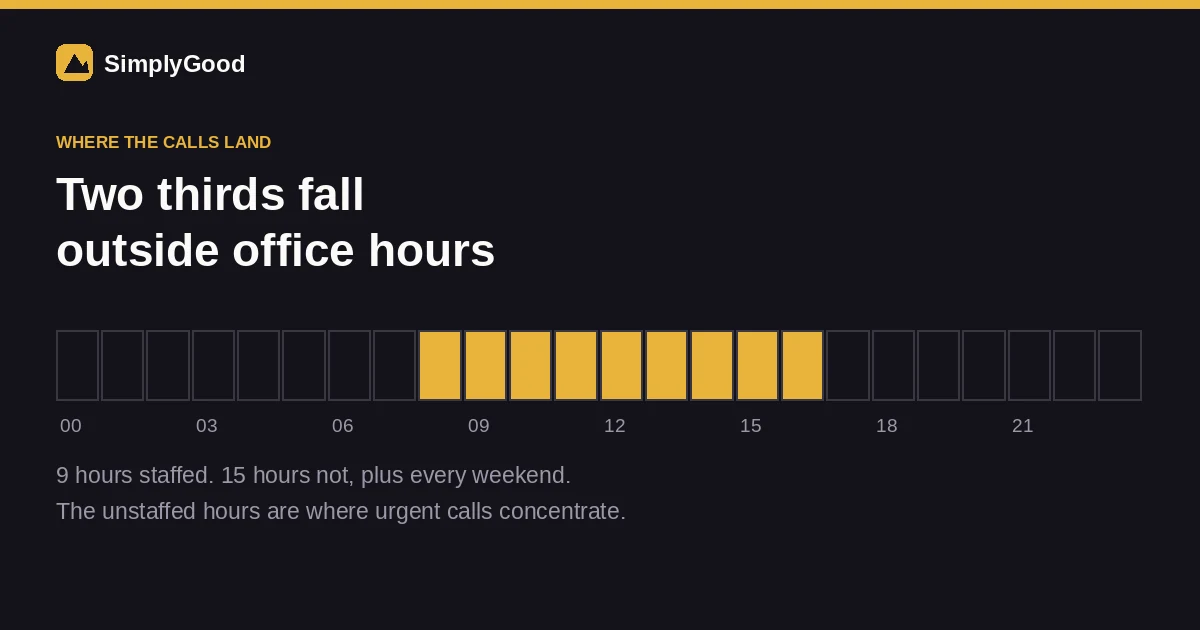 Nine hours covered. Fifteen not, plus every weekend — 120 hours a week against 45.
The arithmetic nobody does
A standard week has 168 hours. A business open 8am to 5pm on weekdays is staffed for 45 of them. That is 27% of the week.
Call volume is not distributed evenly, so the missing 73% is not 73% of your calls, but it is a lot more than most owners assume, and the shape of it is the interesting part.
Three distinct patterns fill the unstaffed hours:
The evening admin window, roughly 6pm–9pm. This is when people deal with the things they meant to deal with. It is not urgent work — it is quotes, bookings, “how much would it be to”. These are high-value calls because the caller is calm, has time, and is comparing options. They are also the calls most likely to go to whoever answers, because nothing forces them back to you tomorrow.
The early window, 6am–8am. Trades ringing trades, and anyone whose day starts before yours. In agricultural markets like Fresno or Lubbock this is a substantial slice of genuine commercial enquiry, and it lands two hours before most offices open.
The genuine overnight emergency. Small in volume, disproportionate in value, and the most likely to be won by whoever picks up first. Nobody rings three plumbers at 2am.
Add weekends, which are 48 hours of the same evening-admin behaviour spread across two days.
Working out your own number
The generic statistics are worth ignoring. Yours are in your phone system, and getting them takes about an hour.
Step one: export twelve weeks of call logs. Any VoIP provider will do this. You want timestamp, direction, duration, and answered/missed.
Step two: bucket by hour and by answered. A pivot table is enough. You are looking for how many inbound calls arrived outside your staffed window, and what proportion of those went unanswered, which for most businesses is close to all of them.
Step three: strip out the noise. Repeat attempts within an hour are one caller, not three. Spam is not a lost customer. Both inflate the raw figure and neither is recoverable revenue. This usually takes 20–30% off the headline.
Step four: apply your real close rate. Not your hoped-for one — the rate at which answered enquiries turn into jobs. Most trades know this roughly. Multiply by average job value.
What you end up with is a monthly figure for after-hours revenue that went somewhere else.
That number is the entire business case, and it is the only one that should drive the decision. Compare it against what coverage would cost you. If the gap is small, do nothing — genuinely, and ignore anyone telling you otherwise. If it is several times the monthly cost of covering those hours, the arithmetic is not close.
Do this calculation before you talk to any vendor, including us. Walking into that conversation with your own number is the difference between evaluating a proposal and being sold one.
Why voicemail does not recover it
The instinctive fix is a better answerphone message, and it is worth being clear about why that does so little.
Voicemail asks a caller to wait through a greeting, compose a message unprompted, and then wait an unknown period for a response. The third part is what kills it. They have no idea whether you will ring back in ten minutes or on Tuesday, and they have a problem now.
The alternative available to them costs two seconds: hang up and tap the next search result. Where a search happened at all, the next listing is right there — the caller does not even need to go back and look.
This is why callback rates from voicemail are so poor, and why they get worse the more urgent the call. Someone booking a haircut might leave a message. Someone standing in water will not.
The implication is that improving your voicemail is optimising a step you want people to skip. The win is in not reaching it.
The four realistic options
There are only four things you can actually do about the unstaffed hours, and they suit different businesses.
Do nothing, deliberately. If your after-hours volume is genuinely low and your work is not urgency-led, this is a legitimate choice. A wedding photographer does not lose bookings to a Tuesday 11pm call. Do the measurement first, then decide — the mistake is doing nothing by default without knowing the number.
Divert to a mobile. Cheap and immediate. It also means someone is permanently on call, which works for a year and then quietly becomes the reason a good employee leaves. Sustainable only with a genuine rota, and most small teams do not have enough people for one.
An answering service. A human answers, takes a message, passes it on. Better than voicemail because the caller gets a person. Weaker than it sounds because the person does not know your business, cannot answer a pricing question, and usually cannot book into your calendar, so the caller still has to wait for a callback. We compare the mechanics properly in the answering service guide.
An AI agent. Answers immediately, knows your services and prices, books into the calendar, captures what an engineer needs. Handles ten simultaneous calls during a storm. Fails on distress and on anything unusual, which is why it needs a defined escalation path.
Most businesses that measure the gap properly end up somewhere between the last two, and the choice turns on call complexity rather than cost.
The storm problem
There is a specific version of this that costs more than the steady overnight drip, and it is worth planning for separately.
Some markets get demand in bursts. A Little Rock spring storm evening, a Des Moines derecho, an ice event across the Springfield Ozarks, a hard freeze in Sioux Falls. In three hours a business receives a fortnight of calls.
No staffing model handles that. One person on call takes one call at a time, and the twelfth caller has already rung someone else. This is the situation where concurrency matters more than quality — an agent that handles all twelve adequately beats a person who handles one of them well, because the other eleven jobs are gone either way.
If your market has this pattern, the burst is probably worth more than the routine after-hours volume, and it should drive the decision.
What to expect if you fix it
What to look for, and what not to expect. These are the mechanisms rather than promises — measure each one yourself before and after.
Response time collapses. From hours to seconds. This is the change with the largest effect, and it is the one with genuine evidence behind it: research on lead response timing has consistently found that the odds of making contact fall sharply within the first hour.
Evening bookings appear immediately. Usually in week one, and they are visible in the calendar rather than needing to be inferred.
Weekend enquiries stop evaporating. For trades this is often the biggest single line.
Some calls still fail. Distress, complaints, unusual requests. Plan for it, route it, do not treat it as the system not working.
The number of calls you win from a storm goes up sharply. If you are in one of those markets, this is where the payback actually sits.
What you should not expect is that every after-hours call converts. Some of those callers were always going to ring three companies. You are moving from a near-zero capture rate to a partial one, and partial is where all the value is.
A sequencing note
If you are going to do this, do it in the right order or you will draw the wrong conclusion.
Measure first — twelve weeks of logs, cleaned. Then decide whether the number justifies anything. Then start with the narrowest scope that addresses the biggest bucket, which for most businesses is evening bookings rather than overnight emergencies. Get that working and measured for a month before extending.
The failure mode is going straight to full 24-hour coverage across every call type, discovering the emergency handling is not right, and concluding the whole thing does not work — when the evening booking capture was fine and would have paid for itself on its own.
The hidden second cost
There is a cost to the unstaffed hours that does not show up as a missed call at all, and for some businesses it is larger than the lost revenue.
It is the owner answering the phone.
In most small service businesses the after-hours “solution” is a diverted mobile in the owner’s pocket. That covers the calls, and it means the person whose attention is worth most is fielding routine booking enquiries at eight in the evening — badly, because they are eating dinner, and without the calendar in front of them, so half the bookings get written on the back of something and entered tomorrow if at all.
Two things follow from this. The obvious one is that the owner never stops working, which is a durability problem rather than a financial one but eventually becomes both. The less obvious one is that these calls are captured worse than the office captures them. Details get missed. Slots get double-booked. The customer who rang at 8pm gets a callback the next afternoon to confirm what was already agreed.
If this is your current arrangement, the measurement in the previous section understates your problem. You are not losing those calls — you are paying for them twice.
Frequently asked
How far back should I pull call logs? Twelve weeks minimum. Four weeks will catch a seasonal anomaly and mislead you.
My phone system does not report missed calls. Then tally manually for two weeks. Tedious, and still better than guessing. Or move to a provider that reports properly — it is the cheapest change on this list.
Should I advertise that I am available 24/7? Only if you are. Advertising it and then failing an overnight call is worse than not advertising it, because you have set an expectation the caller will remember.
What about a shared on-call rota? It works with enough people and a real rotation. With three staff it becomes one person’s permanent burden within a couple of months.
Does answering out of hours actually change close rates? Being first to respond matters more the more urgent the job is. For emergency-led trades it is close to decisive; for planned work it is an advantage rather than the whole game.
Want to know what your own after-hours gap is worth? Send us the shape of your call volume and we will do the arithmetic with you — including telling you if the answer is that it is not worth fixing.